
Modality and Media
Word-Worship and Wisdom Tradition

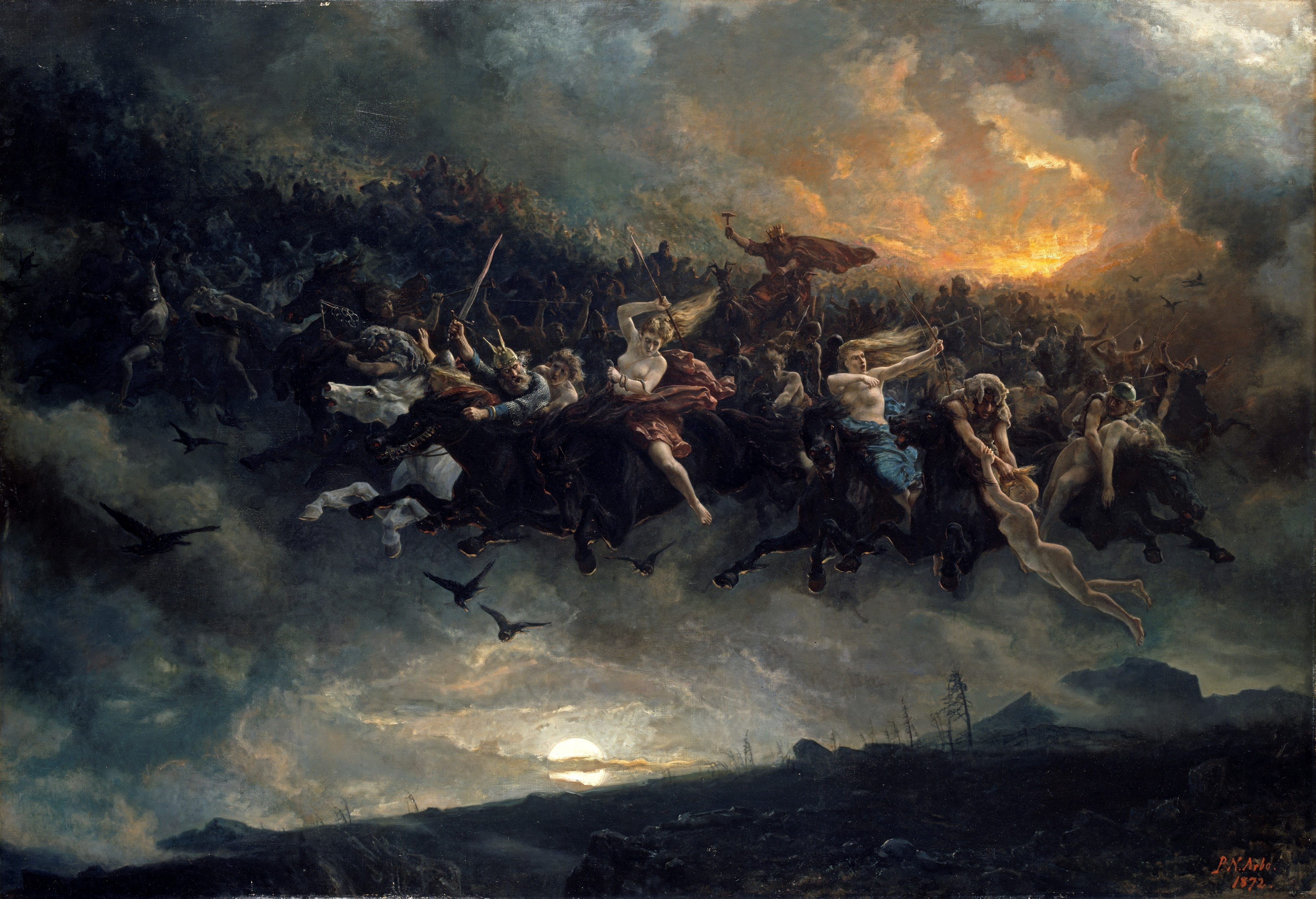
The Wild Hunt of Odin, Peter Nicolai Arbo, 1872
Signal and Noise
Modality and entropy are two concepts inspired by modern communications theory that I’d like to integrate into our approach to historical media.
Previously, we discussed various biases which affect our interpretation of classical myth and media, such as eschatological and teleological biases, as well as religious bias. Here I would like to explore certain types of cognitive bias, as these biases mediate our understanding and interpretation of the religious and philosophical insights of antiquity no less than religious conditioning.
We will also discuss more generally the limits of language and writing, and the understanding of these limits as expressed in antiquity. Various people in antiquity warned against literality, which is to say, they warned us against treatise and testimonial writing as a vehicle for knowledge and informed us that there were limits between the word and true wisdom.
I have mentioned some of these ideas before in previous essays and will cite a brief excerpt from the entry linked below.
Mediation, Myth and Mystery

As part of our ongoing exploration of history and memory, I’d like to investigate a few topics here that are relevant not only to historians but to anyone interested in the transmission, interpretation, and translation of ancient thought.
In that essay, I stated:
…if you take especial pride in your verbosity, in discursive intellect, and in the powers of rationalization, articulation, and expression, this foray into mediation and mediated knowledge may be infuriating. It will likely seem counterintuitive by modern standards. This is partly because we Moderns misunderstand intuition as it was described in tradition, and knowledge as it was known to men previously.
Intuition is described today as a kind of unwilled discursive reasoning, i.e. as a computer brain running a script in the subconscious which then presents us with answers to questions before we ask them in the form of “insight.” But this is not what intuition meant in antiquity.
We must differentiate our ability to engage or formulate ideas with discursive reasoning, a type of mediated experience, from our ability to receive knowledge through intuition and direct experience, our ability to know without thinking. Again, if you have come along this far it is because you enjoy discursive reasoning, but nonetheless, it is here where we must burn the ships.
We will be doing something similar here and burning the ships once again, so to speak.
We will discuss these issues of approach, intention, perception, and reception described above as issues of modality.
Modality relates not only to how we interpret media but how the medium which carries any message can itself be said to influence and shape cognition, perception, and range of expression.
In terms of modality, I also shared in that same essay cited above:
“If we are to discuss man’s capacity to communicate knowledge, we must understand both the limits of that capacity and what the ancients considered to be communicable knowledge, inasmuch as we can infer and understand these things ourselves today from the teachings left to us…
After we understand this, we can begin to understand why they chose to write the things they wrote, why they stayed silent on so many other matters, on things which they surely knew and understood, but simply did not say, or rather, did not write down.
So here we must distinguish between direct knowledge received by experience and intuition, which is wisdom, and discursive knowledge, which are merely the thoughts and ideas we experience, and things only partly and imperfectly perceived.”
This passage too, will tie in with our conception of modality.
In terms of transmissibility, we must discuss entropy, which refers to the degradation, alteration, deterioration, adulteration, or failure of a signal over time. This can be due to natural processes, neglect, interference, or simply decoherence.
The roots of this concept, entropy, can be found in antiquity, though we are partly referencing ideas and employing more modern terminology aligned with the so-called Toronto School of Communication Theory, which produced thinkers such as Marshall McCluhan, Eric Havelock and Harold Innis.
So far, we have mainly discussed the effects of entropy in terms of mistranslation, for example, as millennia of Christian scribes understated, restated, or mischaracterized pre-Christian philosophical and religious concepts, and how we have inherited their bias today regardless of whether we hold to Christian doctrines or dogma. We will travel a bit further down that road today.
The Word
The scribal, monkish traditions felt compelled to depict the religious traditions and moral philosophy of pre-Christian antiquity as barbaric and bloodthirsty and lacking any universal insight or application, and so wrongfully accused them of tribal or national characteristics, of simplicity, which partly gave us the term “paganism,” but in the most absurd cases where they had to admit semblance and insight, from highly cosmopolitan thinkers, they simply dismissed these cases as being devilishly imitative of Christian doctrine and so obviously “placed” by the devil to confuse good Christians, or else they retroactively granted such thinkers and ideas some special status.
We will discuss their approach to textual media in some places, just as we have before, but our concept of entropy here assumes that any medium for communications is necessarily imperfect and imprecise, even under the best circumstances, regardless of whether malice or ignorance seeks to disrupt the signal later.
Indeed, although multiple myths describe writing as being a divine gift from the Gods, to my knowledge not a single nation worshipped script with such certainty as we do today, and few truly entrusted script with carrying sacred insight. For this reason, we cannot make the mistake ourselves of enshrining the written word itself as a deity, believing it to be perfected or perfectible, as it is most certainly not.
And so the concept of entropy is to be understood in terms of the degradation of a signal, depiction, or message, and is not limited to atmospheric interference, as in a radio transmission, but also to natural processes, such as rain washing away a chalk drawing on a sidewalk. Whether media is textual, visual, or aural, every medium of transmission faces limitations in expression, but also in durability. Both challenge the integrity of what me call the message to survive.
Because of these limitations, we must weave our web using other historical and scientific analysis to determine context. This phenomenon, of not simply relying on the word, should be non-controversial and self-evident, but can be particularly painful to admit for the Verbcel, so we will discuss the Verbcel’s error in brief.
The Verbcel, in internet parlance, is a portmanteau which combines the self-obsession and neuroticism of the online Incel community and pairs it with a person who has great passion for the written word, debate, and argument, i.e. the Verb. I mean to use this term in a largely self-deprecatory sense, as I myself love words, language, and discursive thought so much, I must be the first to admit that I possess these tendencies myself.
But for the purpose of demonstration, consider what the Verbcel must believe in the most extreme context. The Verbcel, as word-worshipper, believes the written word is fully stable and reliable, and so would defend the power of text just as fervently as any engineer or architect would defend the power of reinforced concrete. No one would argue that words or concrete can’t be durable or reliable. If I myself believed that, there would be no purpose in writing, would there?
But we must admit that this belief is false when we consider entropy. Concrete can be broken down over time. It also can be vandalized. Why should we view words and text any differently? If this outrages you to admit, consider whether you have inherited some supernatural faith in textuality and verbosity. Again, we probably all have some unexamined Verbcel assumptions and tendencies, through no fault of our own, and there is nothing to be ashamed of, but if this does outrage you, consider why.
I am simply pointing out here, that this hypertextualist interpretation alienates us from historical media no less than any overt religious bias, and it has both cognitive and psychological implications. I previously referred to Abrahamism as having a dependency on literalist and testimonialist interpretation, and indeed this is likely where we have gotten these tendencies, but it can’t be assigned solely to Abrahamism.
Abrahamism’s position at the threshold of civilization’s transition from oral and experiential conceptions of knowledge and wisdom to the primacy of the written word and the concepts of acquisitive knowledge is not coincidental. There might have been few Verbcels prior to Abrahamism, but Abrahamism, and most especially Christianity, being most facilitated by squabbling scribes and clerks, was absolutely critical to the ascendance of Verbceldom over the minds of the West. We have simply inherited their modal bias to textual media.
Our modern orientation towards hypertextuality places enormous trust in textual media as a reliable “container of ideas,” largely because textual media is seen as the “messenger of God,” being entrusted with the most sacred communications, whether the Torah, the Bible, or the Quran. This transition to the primacy of textuality did not occur until the treatise and testimonial writing of early Christianity prevailed.
Prior to this transition, virtually no society in antiquity believed wisdom or religious insight was acquired simply by possessing or understanding a text through discursive reasoning and merely adjusting one’s belief or rites accordingly. There were few, if any, Verbcels in antiquity. The writers and thinkers of antiquity did not place half as much faith in the spoken word, let alone the written word to convey the highest meanings or to transmit true wisdom.
If we are to be honest in our approach to the ideas, personalities, and media from antiquity, we must consider the possibility that we assign to these people our own “media orientation,” so to speak, assuming them to be either Verbcels or hypertextuals as we are today. If we persist in this error, aren’t we every bit as guilty of anachronistic projection as any Leftist who claims Elagabulus or Caligula were “trans,” or Zenobia as “feminist,” or Leonidas as “Fascist,” or so on?
I explored in my second entry how insights from antiquity, which we’ve come to interpret as representing occulted or prestigious insight in our focus on textuality, were truly not great secrets. If anything, they were thought of as simple insights and probably taken for granted by many people, if not most, as being obvious.
When we obsess and agonize over text and textual interpretation, these are precisely the contextual insights that we miss.
The Warning
To understand ancient media, but perhaps most especially textual media, we must address not only the difficulties involving the transmission and translation of the text, but also issues with irony and the problem of ineffability, which we must gather from context.
Wisdom was almost everywhere understood in antiquity to be experiential and operative. It was lived. Of course, I’m not discounting here metaphorical or allegorical writing, which often seeks to instruct a reader on how to participate or think by a certain method, and thereon perform a kind of internal operation on their own, nor am I talking about ironic or esoteric writing, which is similar, as these methods were most certainly used by many writers to communicate insights about wisdom.
But the distinction here is that prior to prevalence of Abrahamic textuality no one believed the most profound experiences of humanity or divinity were to be found contained in words, whether written or otherwise. And so by reading, one could not simply acquire this knowledge. One could not open the container and receive the prize, so to speak. Our present reality is quite different from this age, as we inhabit a world today where the written word has enjoyed primacy for millennia, and pull lever, receive prize, is exactly what we expect.
The shift from orality, to textuality, and now to hypertextuality, has radically altered our conceptions about the nature of knowledge, divinity, and wisdom. I am not claiming original insight here or stating this to be evidence of some grand conspiracy, and various authors across various disciplines have each given some insight into this transformation, including Marshall McLuhan, Thomas de Zengotita, and Nicholas Carr, to name a few.
Hypertextuals
Hypertextuality is partly what I spoke about in my previous entry regarding AI, as anyone with a subscription to ChatGPT now has access to “strings” of argument and quite broad topical layers of semantic insights for whichever purpose they so desire. But can they be said to possess insight or wisdom? Do they achieve any depth with this or does this instead disperse their attention or seduce it into some other type of interaction altogether?
I argued that the whole premise of interactive LLM’s seems designed to collapse certain types of personalities into solipsistic paralysis, but in regard to our discussion here, how does this represent the natural evolution of our inherited obsession with textuality?
Substack has probably hundreds of writers each week claiming to have uncovered some secret history or secret wisdom, and naturally, their business model is to offer you access to decrypts each week which will grant you an understanding of “real history” for five dollars a month.
By the same methods, rabbis too have wrenched every possible meaning out of the Torah for centuries and twisted it to whatever purpose was convenient. Notice how each writer on such subjects claims to have received their own tablets from Heaven, or to possess some new cipher, or skeleton key?
I am offering precisely the opposite here, that our understanding of “real history” is more contingent on other scientific and historical disciplines, but also includes self-discipline, and there is no mere string of words that one can acquire to unlock understanding.
What we have mainly discussed above is the unreliability of both orality and textuality according to ancient thought, and also in brief the psychological and cognitive effects that modern hypertextuality has on our appreciation for classical insight.
Wisdom is not a matter of “thinking correctly” or of acquiring the correct information, or forming the right opinion, but is gained more simply through disciplined interaction with both our own interiority and that of others, as well as dedicated and unvoiced action out there, off the screen, out in the world. This is no great secret.
As a last comment on this phenomenon, this obsession with textuality, decryption, and meaning, I would say this: if twentieth century post-modernist/deconstructionist movements have taught us anything, it should be that one can turn “Winnie the Pooh” into an allegorical elaboration on Gender Theory, Fascism, or Nietzschean overcoming if we so wish.
This phenomenon is no different with the New Testament or the Torah and our tendency to obsess, decrypt, and deconstruct probably springs from the same branch, just as modern Liberal Progressivism is sprung from the Sermon on the Mount.
Far from being reliable, stable, and static, the weaknesses of textuality are quite obvious, and these flaws have been made much worse by the false confidence we’ve placed in the medium.
To Shut the Mouth
Man’s default mode in antiquity, before he found himself under the yoke of the written word, was to acknowledge that the deepest mysteries of religion and philosophy were simply inexpressible and ineffable, and required experiential and operative ritual.
But what do these terms mean to us today and how do we rediscover these meanings through reading? Again, while we can’t communicate this type of wisdom explicitly, we can describe how our modality in approaching myths and other works with religious and philosophical themes affects our experiences with it, and thus may inform our experience of other phenomena in the world, which was precisely the point of most ancient religious texts, being understood as imitative, operative, scripts and not instruction manuals or containers of wisdom.
Time and again we are referred by ancient media to ineffability or else presented with conundrums, riddles, enigmas, and mysteries. We also discussed previously the origin of this word, mystery, which has come down to us with an almost enigmatical meaning today, so we will discuss it once again but in more detail before closing out with how differently man viewed the nature of wisdom itself.
The word mystery has come down to us as signifying some hidden truth, secret, or puzzle to be solved, but the meaning in antiquity was associated with the experience of wisdom itself. The word signified that there are some things which can only be experienced through rite, ritual, or action, and even then, they are only truly received via divine intervention or revelation.
A mystery as we think of it today is something that can be solved, it is an equation that can be balanced, with enough evidence, or clues, or pieces, it is something which can be put into place. This modern interpretation again reveals something about our hypertextual approach to knowledge itself as being something acquisitive or additive, in that we fail to differentiate discursive knowledge from wisdom as the ancients did.
To most of us, wisdom is merely a matter of finding the right words, or perhaps finding the right argument, or the right opinion, but not so in antiquity. We can consider the practices of mystery cults in antiquity as one such proof for this once commonly held belief, inasmuch as we can contextualize those practices today.
Rites and Ritual Procession
Of course, anyone interested in the period knows that various rites and rituals were practiced around the ancient world prior to Christianity, such as the Orphico-Dionysian, Samothracian, and Eleusinian Mysteries.
The word “mystery” itself is taken to be derivative of the word muo, meaning “to shut,” as in “to shut the mouth,” or “to shut the mouth and eyes,” and as we’ve noted previously it was instead the personalized secrecy of those rites which came to be associated with our word “mystery” rather than the implications of the word itself, and what it signified in antiquity.
This can be hard for us to understand today in a world where people detail every perception and conscious thought on social media, ever-preening and cultivating digital avatars and personas, and sharing. We live in a performative era, where this sharing is nearly constant, but yet everyone seems to be far more alienated than before. Why? If we are sharing so much more, allegedly, why is alienation the result?
The likely reason we suffer from a lack of authenticity, intimacy, and directness of experience is because nearly every experience of reality is mediated.
In seeking to share and record everything, every mundane instant, every thought, every moment, we create distance between ourselves and profound experience. In cultivating persona and obsessing over mere appearance, we lose our fundamental sense of self.
Perhaps this is why 2/3 of the population in Western societies or more have some dependence on anxiolytics, alcohol, or some other disinhibitory pharmaceutical to merely go out for groceries without having a complete nervous breakdown?
This is precisely as described in antiquity, but as Thomas de Zengotita described in his preface to the book “Mediated: How the Media Shapes Your World and the Way You Live in It,” stating:
… millions of human beings are trapped in realities so restrictive, so desperate, that the possibility of applying to them what I have to say in this book does not arise at all.
But the issue of the trend remains, for it is global. And so does the issue of mediated reality in relation to the immiseration of those millions, not as it is lived, but as it is experienced by the rest of us, by privileged citizens of the overdeveloped world who can choose to deal with it.
He continues:
Ask yourself this: did members of the Greatest Generation spend a lot of time talking about where they were and what they did and how they felt when they first heard the news from Pearl Harbor?
People certainly remembered the moment, and a few anecdotes got passed around—but did a whole folk genre spontaneously emerge?
Did everyone feel compelled to craft a little narrative, starring me, an oft-repeated and inevitably embellished story-for-the-ages reporting on my personal experience of the Event? Or did they just assume that Pearl Harbor and its consequences were what mattered, and talk about that.
In an operative sense, when we “shut the mouth,” we not only rely on the other senses but we force the primary vehicle of dialectical expression, the voice, inwards upon itself, or in the case of shutting both the mouth and the eyes, the inference is that we suspend discursive thought and the perception of material spectacle altogether. As stated before, even discursive thought, our ever-bubbling ability to textualize and rationalize our experience of the world, is itself a form of mediation.
The Abrahamic view is that when one names something, such as a devil, for example, one can gain control or dominion over it. Much of the thought of antiquity believed the inverse, that the process of naming was a profanity in and of itself, and that the most sacred and meaningful things not only could not but should not be spoken.
Consider also de Zengotita’s explanation of the cognitive and psychological effects of mediation, of posturing and preening, and what incessant verbosity and discursivity grants us if left unchecked:
You had a sort of God’s eye view.
This is a form of flattery so pervasive, so fundamental to the very nature of representation, that it has escaped notice, though it ultimately accounts for the much-remarked narcissism of our age.
The flattered self is a mediated self, and the alchemy of mediation, the osmotic process through which reality and representation fuse, gets carried into our psyches by the irresistible flattery that goes with being incessantly addressed.
They say that the architecture and the landscaping at Versailles were originally designed to provide His Highness with various commanding vantage points, positions that made it seem as if the whole world were spread out before him, naked to his gaze.
That’s peanuts compared to what mediation makes possible for all of us today.
At the most general conceptual level, mediation means dealing with reality through something else. Marshall McLuhan, Godfather of Media Studies, thought of mechanical tools as media because, as artifacts that come between us and the given, they were “extensions of man,” and so could be said to “mediate” in a certain sense.
But this isn’t an academic treatise. In this book, mediation refers to arts and artifacts that represent, that communicate—but also, and especially, to their effects on the way we experience the world, and ourselves in it.
What would we call this state described in antiquity then, this sense of mystery, which is beyond both words and beyond physical sight, and can we truly imagine such a thing today, in our hypermediated, hypertextual existence?
I’d argue that what remains when we “shut the mouth” is not dissociation from reality or a retreat into sensuality, but rather what modern psychology (and Buddhism) might instead call a state of mindfulness, which is nothing more than an experience of being fully enraptured in the present moment, or fully present in the present. It is to open oneself to the directness of experience.
I’m not arguing that the classical mysteries were merely therapeutic or based mainly on the physiological mechanics of sense deprivation. They were most certainly not reductive but intended to be conductive, and so oriented ever upwards and outwards.
Most of what we know about ritual experiences related to expanding, raising, increasing, and enhancing man’s experience, not reducing it to animalistic impulse, which was merely taken sometimes as a necessary entry point to rebuilding conscious experience and transcending it.
Cloistered monks, in retrospect, were so absolutely titillated by the sensuousness and passion described in these rites, and so deprived of ritual play and desire, they often declared accounts of the rites to be beastly and devilish, after thinking about it perhaps a bit too long. And we know various mystery rites made use of both extreme and dramatic spectacle from time to time, such as ritual drama and enactment which involved the production of theatrical visions but also ritual sacrifice that probably involved mutilation.
We also know of rites which required vocal chorus and movement, such as chanting, dancing, and singing, and actors sometimes played individual parts in ritual plays and pageantry. Intoxicants were often used in these rites but again, the purpose of the intoxication, inasmuch as we can infer these aims from evidence and context, was rather to facilitate the ritual procession from one state (dialectical) to another (anagogical), and so was always oriented towards divine reenactment and alignment, not into animal stupor or for the sake of “good vibes.”
Even the Orphico-Dionysian rites, which were described as frenzied or drunken, were nonetheless still oriented upwards in that they were dedicated to man’s communion with a God. A suffering God, yes, but a God no less who resided in Heaven and had given a piece of his immortality to man.
Man’s ritual intoxication under the Orphico-Dionysian rites was taken as proof of his connection to Heaven, and also proof of Heaven’s favor and sympathy in gifting him both the vine and wine, which could bolster his soul beyond the bounds of mundane existence. Man’s experience of relief and ecstasy as facilitated through the effects of alcohol not only proved that his soul was capable of release from earthly suffering and routine care, but proof he possessed a share in divine immortality, as that gift was bestowed by the sacrifice and suffering of Dionysus, and so via intoxication man enacted his own release from care and suffering, and felt the proofs within his own soul, by direct experience.
I realize this is much exposition on Greek ritual and religion, but such experiences, we are told, in absolutely no uncertain terms, must be experienced to be known.
They were not acquired by text or by study. There was no single book which explained them. Ask yourself whether you have ever read about the effects of intoxication or pharmacology or parenthood or love, and then found yourself completely beyond the realm of description once you actually entered such a state.
It is simply beyond the abilities of words and text to give us these experiences described above. They are beyond reasoning but yet, they may still be known and partially enunciated. However, no intellectual understanding of these experiences grants us insight, nor does intellectual understanding or rationalization deprive us from direct, unmediated experience.
People often form all kinds of preconditions and theories on relationships, for example, but once we feel the pull of attraction or the fullness of love, our carefully collected words and platitudes are inadequate, no matter how much care and time we put into their construction. Instead, these things must simply be experienced to be known, and while we can enact and construct rituals and intellectual superstructures for the purpose of these experiences, even these do not assure completion of the operation, so to speak. Such is the serendipity and tragedy of life.
A marriage does not create love. A birth of a child does not always create love. A death does not always generate an experience of reverence. And so on.
Modality: Ancient and Modern
In terms of the nature of wisdom itself, many of the dialogues of Plato, as well as the teachings of Pythagoras and others, each implied that to know was to be, not merely to acquire knowledge. Note also that to be also implies a certain persistence of being which must also be beyond the realm of experience itself.
One obviously did not acquire wisdom by purchasing a book, or by learning a fact, or understanding a text, but even experience itself was often not enough. One had to be, in order to truly know.
Why?
How could one acquire information but not acquire wisdom, through cumulative or rationally constructed effort?
This lies at the heart of theurgy and divinity in classical thought, where not only experience but wisdom was believed to be received, and one needed to have the right orientation to receive it. Again, this did not always rely on experience.
One did not learn about the immortality of the soul, for example, via discursive reasoning, or even through certain rites, unless one had been blessed. It was something man’s soul came to be from an experience which cannot be fully articulated. This is why initiates into the Eleusinian mysteries, for example, believed they had secured the immortality of their own souls, but the immortality or rather the mobility or development of all souls was not so assured.
When we consider this insight, which is plainly more sophisticated than any notion of acquired wisdom granted through textual understanding, or the coequal path to salvation for all souls, we can begin to see that it is not enough merely to have the right idea or the right understanding of some concept or another. This does not grant us wisdom or secure the positive development of our own soul. And whatever we might say about these things, we can most certainly say that they are outside the realm of hypertextuality and mediated experience, which is the paradigm under which most of us move, live, and think today.
Various ingenious solutions were sought in antiquity to this problem of ineffability and transmissibility, which I would like to consider in future as we discuss entropy. The particular methods we discussed involved communal and ritual intoxication, the reenactment of divine spectacle and myth, and simply lived and received experience with proper reverence and orientation of the soul.
When we compare these types of insights comparatively with Abrahamism’s literalist doctrines, so focused on hypertextuality, and dependent on an acquisitive and highly unstable approach to knowledge, we must acknowledge how Abrahamism has affected our most fundamental experience of being.
Man’s most basic mode of moving, thinking, and perceiving in the world has been significantly transformed by the word, and the book, these mediating things which alienate us from direct experience and from ourselves, so as to effectively alienate us from these types of experiences described in antiquity. Our first order of business must be to rid ourselves of these artificialities, which are merely ideological constructions.
While we discussed here in haphazard fashion some of these ideas and a new conceptual framework for approaching media, we will approach in a future entry both Plato’s “Dialogues” and accounts of Odin and the Runes with this material in mind, considering the limitations of the word and text, as well as classical perspectives on communicability and knowledge generally, and how our inheritance of Abrahamism’s idiosyncrasies can be further overcome.
Excellent work, not sure how I've missed your articles in the past. A mistake to be rectified.
Another thought-provoking piece. You consistently give me a lot to chew on.
This connects with something I've been thinking about a lot lately. Modern life gives us unprecedented access to information, opinions, narratives, and even the inner worlds of other people, yet many of us seem more disconnected, anxious, and alienated than ever.
I sometimes wonder if we've started confusing knowledge with wisdom, visibility with intimacy, and observation with participation. We can read endlessly about life, curate identities around ideas, follow intellectual debates, and feel close to people we've never actually shared a meal, ritual, struggle, or meaningful experience with.
One thing that struck me is how differently many ancients seem to have understood wisdom. Not as something you accumulated through more words, more texts, or better arguments, but something lived, embodied, and encountered directly. It makes me wonder if part of what people are searching for today, whether through religion, festivals, dance, pilgrimage, or other communal experiences, is precisely that sense of participation. Not just thinking about life, but being swept up into something larger than themselves....