
Nothing is Tied Down, II
The Hierarchy of Pain

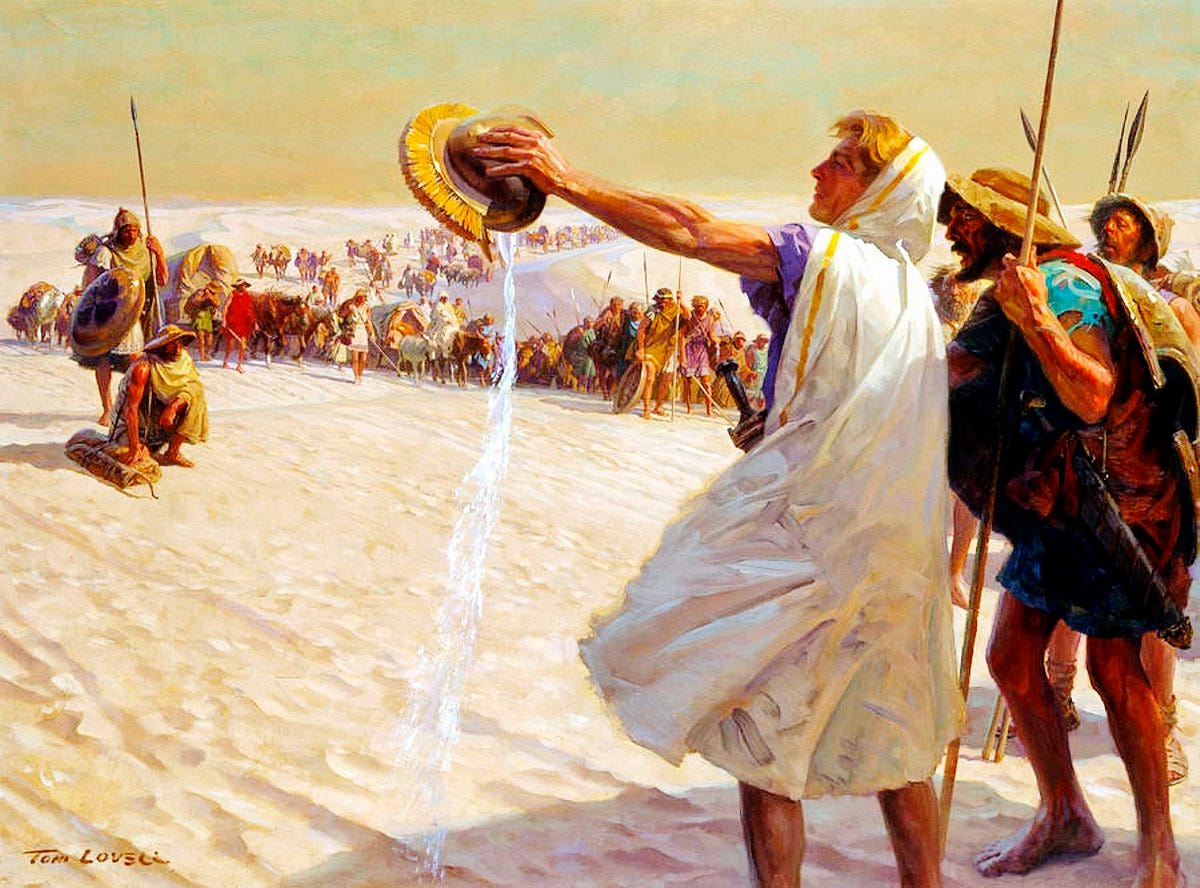
Alexander Refusing Water in the Desert, Tom Lovell, 1968
Ernst Junger famously wrote about how a man’s relationship with pain said more about both his interior state and capacity than skill, abstract philosophy, or mere techne.
In nearly every experience I had in the Army, I found this to be true.
Every infantry soldier is trained to embrace hardship and is told from the beginning to “embrace the suck,” to endure torturous physical training and privation beyond that of the average soldier, and to enjoy it.
Few truly come to enjoy it, but this regimen and philosophy inspires a kind of proud masochism in even the common grunt. I wouldn’t say it is a silent pride, as it is frequently sounded. If you know anyone who was in the infantry, it was likely because they told you about it, repeatedly, even if you never asked. Most infantrymen are quite open about this part of their experience, they are proud to tell you they weren’t just in the Army or the Marine Corps, but in the infantry.
Yet this is something that needs qualified today, as most people who lament the softness of modern militaries usually have no understanding of what an infantry soldier actually does, assuming everyone in the military is sitting behind a keyboard, a turret, or a joystick, and sleeping safe most nights in a fortified base or bunker.
While this might be true for some services and some jobs, this is not the case for the infantryman and never can be, by necessity. The infantryman is a living anachronism, a living testament to what is actually demanded by the God(s) of war in every age, regardless of what is being fought over or about, these God(s) demand blood, pain and dirt.
In the final measure, an infantryman must be willing to crawl in the dirt, going without food and sometimes water, without sleep, and must expose himself to fire and every other kind of torment, if he intends to find and kill his enemy.
The enemy can be bombarded by air, subjected to surveillance, blockaded, tormented, poisoned, demented, and surrounded, but in the end, someone must always be willing to get close enough to cut his throat, or else put rounds into his head and heart, wherever he chooses makes his final stand. Thus, regardless of our technology, our command of air and sea, we will always need the infantry, unless we are simply letting the nukes go off indiscriminately, as any other mode or method falls short.
Of course, anyone willing to do this, and wanting to be good at it, cannot be considered a part of decent society.
This is why the warbands and wolf-bands were sent outside the country and not welcomed back until they had been properly deconditioned. This is why the legions were not permitted to pass the sacred boundaries back into the city, without proper rites being performed first, and all the accoutrements of war being removed and placed back into proper place.
The infantry creates men that can be punished, in a punitive sense, but not shamed, not through any other means than exposed cowardice. You can take away his food and his comfy pillow, but he will like it. He is trained to like it. This serves as a point of pride in the Army and so creates a hierarchy apart from formal rank structure.
Non-grunt soldiers (and commanders) understand there is no evil they could ever wish on a grunt which most would not willingly do to themselves.
Some recognize this, and because they would not willingly trade places with such a cursed creature, they respect this hierarchy, as again, it is based not just on exposure to pain and privation, but one’s orientation towards pain, and almost no other factor.
To be a grunt, even in a modern army, is to possess a radically different relationship with pain and privation than other soldiers. That’s it. There is nothing else to it beyond this.
There is less and worse food, less weatherized gear, less use of tents, beds, and comforts, one has to be happy with their head in the dirt or resting on a gunstock, which again, sounds awful to any creature that desires comfort, above all else, in preference to pain.
But this confrontation with pain is the entire point of being a grunt, this is the telos of the grunt, we might say, and it has been mostly unchanged since Marius’ soldiers were called “mules” in antiquity, in that when they were not fighting, they appeared to be miserably oppressed pack animals.
This is also when soldiers’ songs first appear in Roman history as well, by no coincidence, those great irreverent soldiers’ slanders, often against their very own commanders.
There was a donkey next to my first outpost in Afghanistan with a very cruel owner.
Each day, the farmer staked down the donkey in the field as he checked the progress of his crops. The poor beast was daily loaded with hundreds of pounds of scrap metal, blankets, junk, and dried crops that the farmer scooped up on his daily travels.
The farmer beat the donkey arbitrarily, and pointlessly, and often, and for no reason at all.
The donkey rarely buckled, having broad, muscular flanks and strong shoulders, he never failed in his service to the farmer, but the farmer beat him anyway, and none of us could figure out why, beyond the native cruelty of the Pashtu people.
One day, the farmer staked the donkey and went down towards the riverbank, presumably to scavenge for scrap metal and junk after people had abandoned their homes and villages to Taliban fighters. Roughly 30 minutes after staking the donkey and walking away, we heard a boom and saw a small plume of smoke from the direction of an abandoned village. We wondered whether the cruel farmer had walked over an IED or set off a booby-trapped door.
The donkey startled and stared, and what followed was a perfect analogy for the life we shared with the donkey.
When the farmer did not return after a few hours, the donkey slipped his pack and stood, staring in the direction the farmer had walked for a few hours, nervously shifting his view, sometimes circling uneasily, as if he expected the man to sneak up behind him and beat him by surprise.
But the farmer never returned.
The donkey started chattering. Then he started leaping up a bit on his hindlegs. His shoulders flexed and dropped. A whole transformation came over him. He did what can only be described as “dancing.”
He laughed and bellowed, he hopped up and down, he wiggled, he leapt, and he went on dancing like this in the field for most of the evening, before he dropped to the ground and rolled on his back, legs up in the air, scratching his head on fallow cornstalks, sniffing and snorting, until he fell asleep there in the dirt.
We saw in the donkey some semblance of what we faced ourselves. I have never seen such happiness in any animal. It was one of the most wonderful sights of my life, seeing this creature released from torment and lying on the ground, peacefully, staring off towards the sunset.
We took him water and sugar the next morning, and some dry oats. A few of us scanned out over the no man’s land outside the outpost as two others carried the tribute. He stepped back nervously until they sat the water down in front of him, then he trotted back and forth lightly, showing us all his best parade steps. He was as fine a soldier as I ever saw.
I immediately made the case to our lieutenant that we should commandeer and keep the donkey if his owner didn’t return, making all the practical arguments for bringing him on patrol. He required little food and forage, we knew he could take a beating, and he had the sixth sense for danger that all animals possess. And of course, we knew he could carry gear. It was only half of a joke.
But before I go into any more detail, I should explain why I felt entitled to speak to my commanding officer in this way.
To put it in plainer terms, the infantry is not the Army, it is the infantry, and something else entirely. A junior enlisted infantryman has a voice and may recommend such a thing in the first place, without presumption, so long as this is appropriate to his place in the hierarchy of pain.
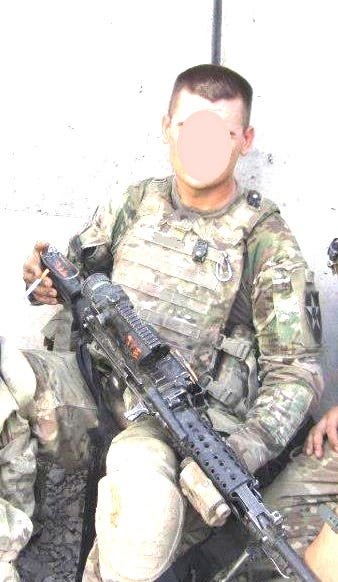
Arghandab River Valley, Afghanistan, Post-Patrol, 2012. Not depicted is my 240L. This is instead a MK48 I fell in on once we arrived in country.
As I described above, while the Army is formally organized around ranks, job codes, and seniority, and there are statutory distinctions between enlisted soldiers and officers, there is, in fact, an entirely separate hierarchy in the Army based on one’s relation to pain.
Even within the infantry itself, this hierarchy extends, informs, and flows through units, independent of rank structure, training, merits, demerits, or time in grade.
I chose early on to not merely endure pain but to change my entire orientation to it. Most men can be trained to endure privation and pain if they are conditioned to believe that this sweetens the enjoyment of future rewards. This is simple conditioning, after all, and is the very essence of the phrase “No Pain, No Gain.”
Of course, this is a very bourgeois notion of soldiering, very Abrahamic as well, in that it is transactional, whereby one takes the pain to deserve the pleasure later. It is a matter of self-control and time preference and can simply be trained.
But my approach to pain was a bit more primitive. It is something else to embrace pain and suffering as the necessary cost of revelation, the cost of wisdom, which we have forgotten today.
As Aeschylus told us, “He who learns must suffer.”
Of course, Odin too had to give up the eye.
And then he had to give up his sanity and stare unblinking with one deathly opened eye hanging over the memory well before he was blessed with inner vision, the mind’s eye view of reality and totality.
This had to occur before he could know the Runes as they could not be taught.
In this respect, most soldiers, even good ones that I knew, rarely “embraced the suck” for the sake of it. They didn’t suffer for the sake of suffering, and instead they looked forward to some treat at the end of the rainbow, some reward stored away on their behalf up in heaven.
As I shared before, I was a bit older than most men in my platoon and by the time we were deployed I was 29 years old, so no doubt my inner life and priorities were much different from the 18 - 25-year-olds who made up most of my unit.
I knew then I was where I wanted to be, I was a soldier, and so I had no desire of future reward. I was not there to pay for college, or to learn a practical skill, as I already had a degree and many skills, but I was there to be what I was to the fullest, and nothing else besides.
As soon as I got to my unit and our pre-deployment training started, I worked as hard as possible to become a machine gunner. In my view at the time, I judged (rightly) that it was the hardest job for a junior grunt, as there was no heavier weapon in the platoon and it required immense conditioning and endurance to simply carry the gun and gear. As the physical burden was the greatest, I saw this as my way to move up in the hierarchy of pain, as I saw it, which is exactly what I wanted.
Most machine gunners carried the M240B/L with a sling, as the weapon itself with a belt of ammo attached is roughly 30 lbs. Gunners were usually assigned an ammo bearer at the time, who carried both a rifle with a few hundred rounds as well as higher caliber spare rounds for the gun. According to infantry standards at the time, a gun team should expect to take no less than 800 - 1000 rounds on patrol. The combined weight of the gun and ammo then being around 80 - 100 lbs, to be shared by two men.
Of course, no one in their right mind would ever take 1000 rounds and expect to survive beyond 30 minutes in a sustained firefight, so I carried between 1200 - 1500 rounds myself in my pack. I had no assistant gunner as my platoon was always at least undermanned by ten men. During most of my patrols in Afghanistan as a gunner, I was carrying roughly 150 lbs. of gun, gear, and ammo (30 lb gun, 75 lbs ammo, 45 lb plates + water). Sometimes this was probably a bit more or a bit less, but in any case, this loadout placed me near the top of the pain hierarchy when it came to patrol operations.
So long as I didn’t bitch on patrol, no one else could bitch. So long as I didn’t hand off my gun or gear, everyone else was expected to hump their own stuff, without asking for help, and so on. This is how a functional hierarchy works, after all, it imposes conformity and order.
Most gunners at the time carried their weapon on a sling, although those who had to use them frequently would tell you that the sling becomes an impediment during an unexpected fight, when the gun needs to be tossed down in the dirt or on a position and jumped on. This is hard to do when it is slung around your neck, and many a gunner found themselves snagged or snared in vegetation and dragged down to the ground, by virtue of the weight and awkwardness of the loadout. I was determined never to let this happen, and so started carrying without a sling, conditioning myself to rotate the gun between arms and shoulders so that my muscles wouldn’t seize up.
By the time I had trained myself off the sling, my lieutenant pulled me in to have words. It was obvious what I was doing, so he asked me to at least bring the sling with me and keep it over my shoulder, even if it wasn’t attached to the gun. I wasn’t being insubordinate, openly, but in my climbing my way up the hierarchy of pain, I was challenging the hierarchy of command in some ways, and my lieutenant knew that he needed to re-assert his authority. I could not fault him for it and he was absolutely correct, and of course I complied, wearing my sling but rarely using it.
The men in my platoon, by virtue of being younger by a few years, often looked to me as if I was inhuman for the things I did on patrol. They always asked me questions about everything. About college. About women. About life. Most treated me like a big brother, so I tried to live up to their expectations. I jumped walls without handing over the gun. While other platoons had clumsy and dumb gunners, I was surgical with my weapon, and graceful, being the best shot in the battalion with the 240 and never falling or complaining (aside from one time when I fell and punctured my shin down to the bone).
I did all of these things without complaint not simply to enforce the hierarchy, and keep us all straight, as it kept us efficient, but because the other soldiers seemed proud that I was their gunner, because they had the best and meanest gunner in the whole battalion and this gave them all bragging rights. They knew that no one could do what I did with the gun.
This is all men really want within such a hierarchy, after all, to be known as the best at something, as the toughest or the most capable. To share in reputation and difficulties. I have never forgotten this as I revisit those old mythological accounts from the Iliad or Arrian or Thucydides. These deeds lived on because this kind of pride of honor is what inspires men, it’s what inspires them to tell stories about war.
It is the same instinct in the soldiers that I’ve known, to tell stories, to praise other men, to tell anyone who can know all about the truly inhuman and more than mundane soldiers, whose stories can barely be believed had you not seen it yourself. All of this is vouched for on reputation, the infantry being a very small world. Comparatively to the wider force, the infantry, both in terms of the Army and the Marine Corps, is an incredibly small community. Whenever I’ve encountered bullshit stories from someone about all the cool guy shit they’ve allegedly done on deployment, I can usually make a few phone calls and find out if they are who they say they are. There is no faking it and truth will always out. The appeal to me, partly, was being known truly by reputation, by deeds.
At the time, as my role placed me near the top of the hierarchy of pain, I also made it a point to say frequently that there was nowhere else I’d rather be and that if given the option, I would do the job for free. Whenever we found ourselves in a particularly shitty situation, on a particularly shitty or long patrol, after a shitty fight, during a shitty op, I would exclaim something like, “You know what, I would probably do this for free if they’d let me. Sir? Can we check on that? Can I donate my paycheck? I love this shit.”
While the other soldiers laughed at first, and I did too, and it became a standing joke in our platoon, by means of some strange operation I found it became true. I wasn’t thinking about being anywhere else, I didn’t want to be back in a soft bed next to a warm woman, with a belly full of food and whiskey, I was well beyond that.
I know this has been a wandering entry, but I wanted to articulate what it is to be a soldier, not merely a hireling hoping for a reward at the end of the tunnel, wishing for a warm bed. In some things, if we are lucky, we find our true calling, our true purpose and telos, and for me, at that time, my purpose was being a soldier. But as I said above, in my recommending we acquire the donkey, I could only say such a thing and demand seriousness from my lieutenant because regardless of rank, he had come to respect me as a soldier, because I had climbed up the ladder of pain.
While the farmer never returned for the donkey, some other Afghans, opportunists that they are, unstaked the poor creature and led him out of the field a few days later, claiming to be near relations of the dead farmer.
While I can’t be certain, we heard a story from some villagers a few days later that the farmer had, in fact, been struck by lightning.
This is no better proof, in my eyes, that the God(s) despise cruelty downwards.
"The Gods despise cruelty downwards"
I can believe this. :)
Thank you for the stories.
I especially appreciate the idea of doing a thing for itself, because of the thing that it IS now, and not digressing (because it IS a digression) by thinking of what IS as an exchange for some notional what WILL BE.
The future, together with any rewards/ punishments it may hold, simply does not exist. What exists is here now, and to savour it, experience it, live it, in full, seems to be about right.
I relate to this story coming in as an old guy at 25 and turning 31 on deployment at CNS. Thanks for sharing your story and showing how informal leadership lessons are often the most valuable. Your men saw your choices and actions, and I’m sure they won’t forget them.